
How to Use Juror Questionnaires Effectively
Jurors are considerably more candid on paper than they are standing up in a courtroom. The social pressures that produce canned answers in open court — wanting to appear fair, not wanting to stand out, not wanting to offend the judge — are largely absent when a juror fills out a written questionnaire alone. A well-designed supplemental juror questionnaire is not a substitute for careful voir dire, but it can dramatically raise the floor of useful disclosure before voir dire even begins.
Why questionnaires produce more honest answers
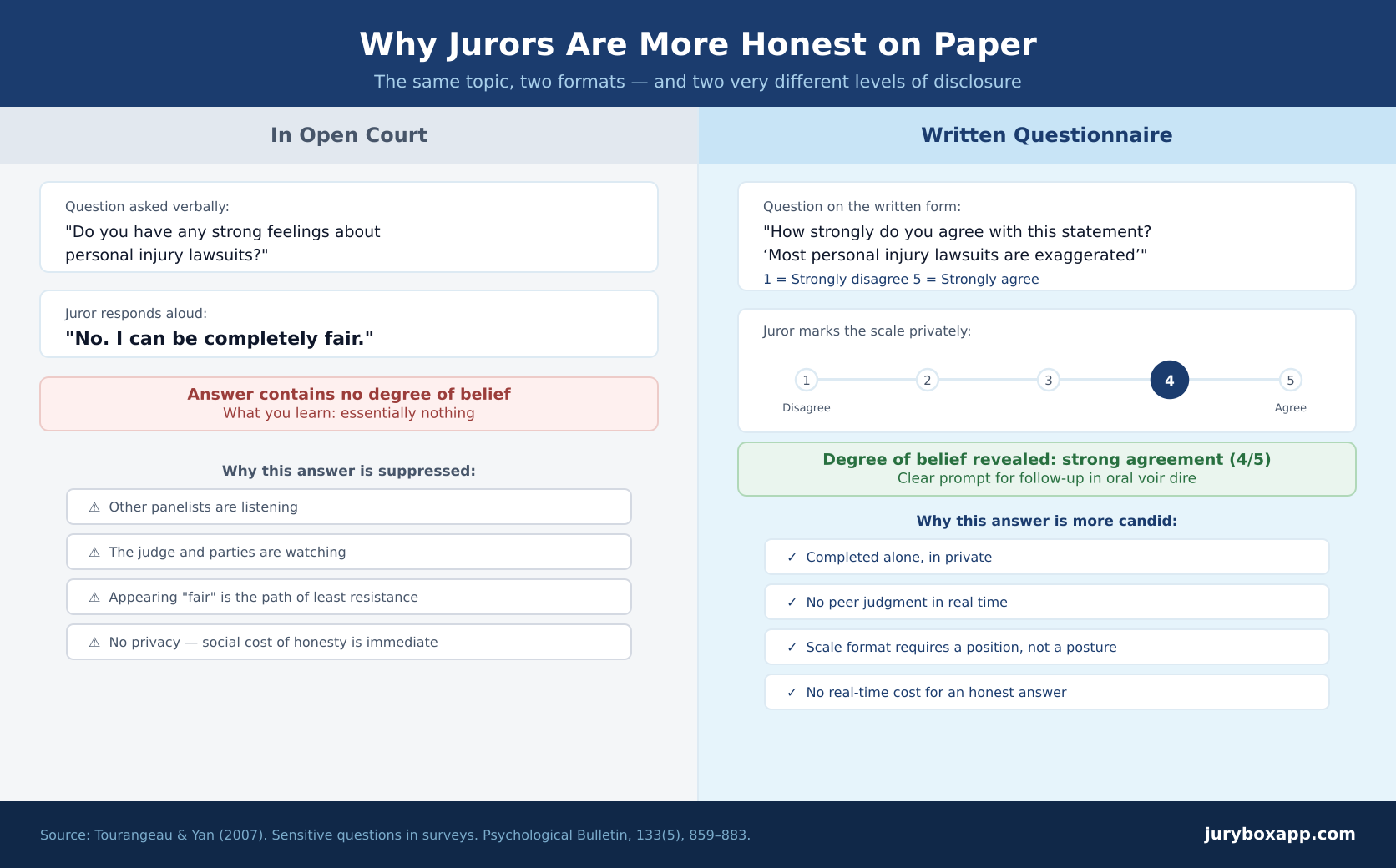
The mechanism is well documented in survey research. Tourangeau and Yan (2007) established that sensitive questions — those touching on socially stigmatized beliefs, embarrassing experiences, or personal history — receive substantially more accurate responses in written, self-administered formats than in face-to-face interviews. The difference is driven by social desirability: people manage how they appear to others, and they manage it less when no one is watching.
Jury selection is a textbook social desirability environment. The courtroom is formal, the parties are present, the stakes are visible, and jurors are acutely aware that their answers are being evaluated. These conditions push jurors toward aspirational answers — "I can be fair," "I don't have any strong opinions" — rather than candid ones. A written questionnaire removes most of those pressures. Jurors complete it without other panelists hearing their answers, without having to hold eye contact with the judge, and without the immediate social consequence of saying something that might seem unacceptable. That changes what they disclose.
When and how to request a supplemental questionnaire
The process for obtaining a supplemental juror questionnaire varies by jurisdiction. In federal courts and most state courts, you must submit a motion requesting permission to use one; some judges grant them routinely in complex or high-profile matters, others use them sparingly. File the motion early — courts that grant questionnaire requests typically administer them to the venire within a week or two before trial, which means your filing deadline may need to precede trial by several months depending on the judge's standing orders. Confirm the timing requirements for your specific courtroom before the trial schedule is set.
The form of the questionnaire requires court approval in most jurisdictions. Both sides typically have the opportunity to propose questions; the court may accept, reject, or modify them. Build in time for that exchange. If you are submitting proposed questions for the first time in a particular courtroom, ask opposing counsel early whether they have a prior model that the judge has approved — proposals that resemble something the judge has already accepted are more likely to be granted with limited revision.
What to include: five categories of questions
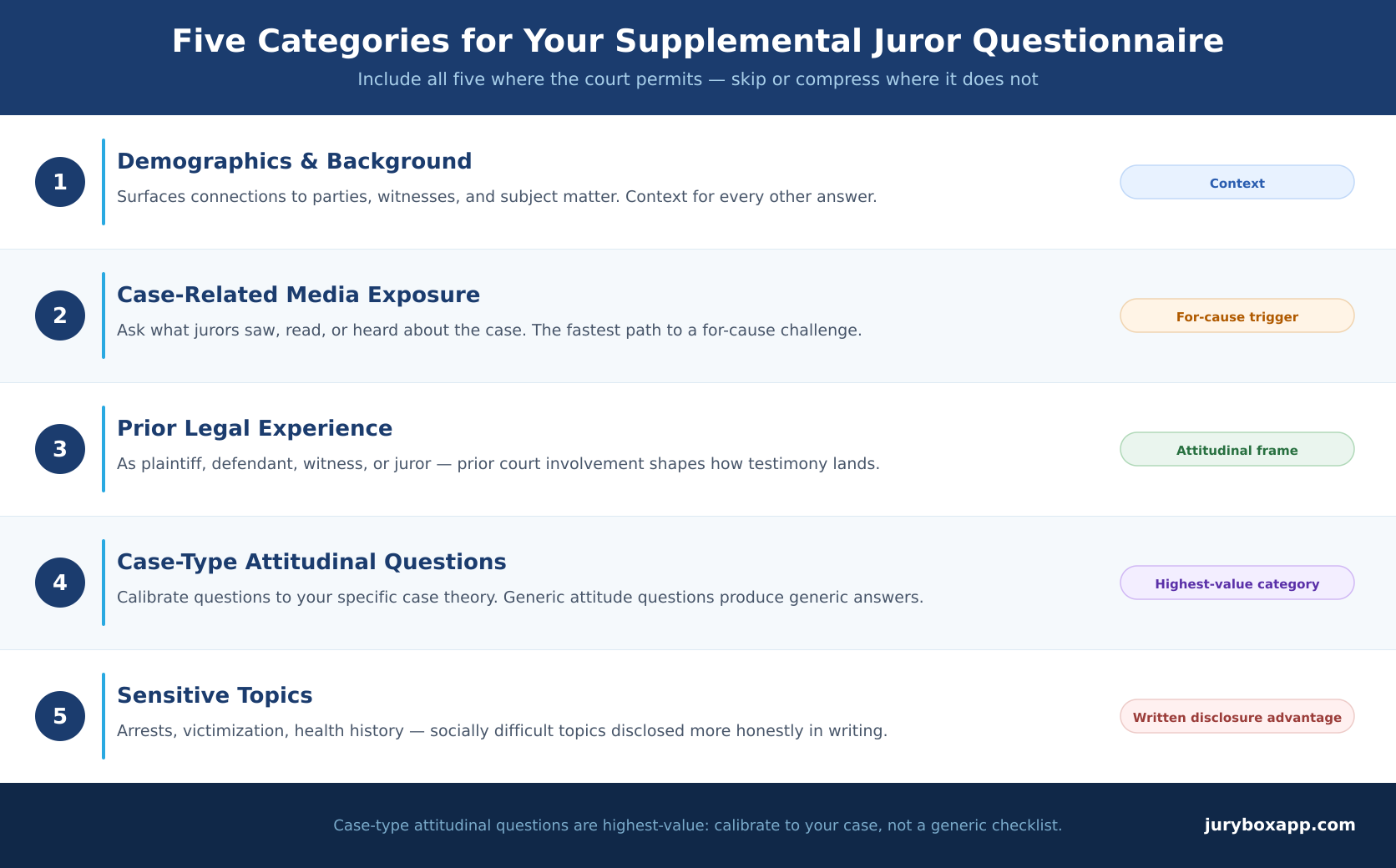
Not every topic belongs in a questionnaire, and courts will reject questions that are overly invasive, irrelevant to the case, or duplicative of information the court will collect directly. Focus on information that is genuinely useful for challenge decisions and that you are unlikely to surface through open voir dire. Five categories appear consistently across well-designed questionnaires:
Demographics and background. Basic information — occupation, education, family composition, residential history — provides context for everything else. It is not predictive on its own (as covered in our guide to identifying juror bias, demographic shortcuts produce weak and case-specific predictions), but it anchors the rest of the questionnaire and surfaces connections to the parties, witnesses, or subject matter that a juror might not volunteer in court.
Case-related media exposure. If the case has received any news coverage, prior publicity, or social media attention, ask jurors directly whether they have seen or read anything about it and what they recall. This is often the fastest path to a for-cause challenge. A juror who formed a concrete opinion from news coverage before the questionnaire was distributed should be on your for-cause radar from the moment you review the forms.
Prior legal experience. Prior involvement in litigation — as a plaintiff, defendant, witness, or juror — shapes how people interpret courtroom procedure and credibility. A juror who felt their own lawsuit was handled unfairly carries that experience into the box. Ask about prior jury service specifically, including whether they reached a verdict and, if they are willing to say, how they felt about the process.
Case-type attitudinal questions. The most valuable questionnaire questions are calibrated to your specific case theory. In a medical malpractice case, that means asking about prior experiences with healthcare providers and beliefs about standards of care. In an employment discrimination case, it means asking about prior workplace grievances and beliefs about how common discrimination is. Generic attitude questions produce generic answers; case-specific questions reveal the priors that will actually operate during deliberations.
Sensitive topics. Arrests (whether charged or not), victimization, health history relevant to the case, prior involvement with regulatory agencies or similar defendants — these are topics a juror may not disclose in open court but will often disclose on a written form. Ask about them carefully and without leading language. Not all courts will permit every question in this category, but the ones that are allowed frequently produce the most useful individual disclosures in the entire questionnaire.
How to word questions for maximum disclosure
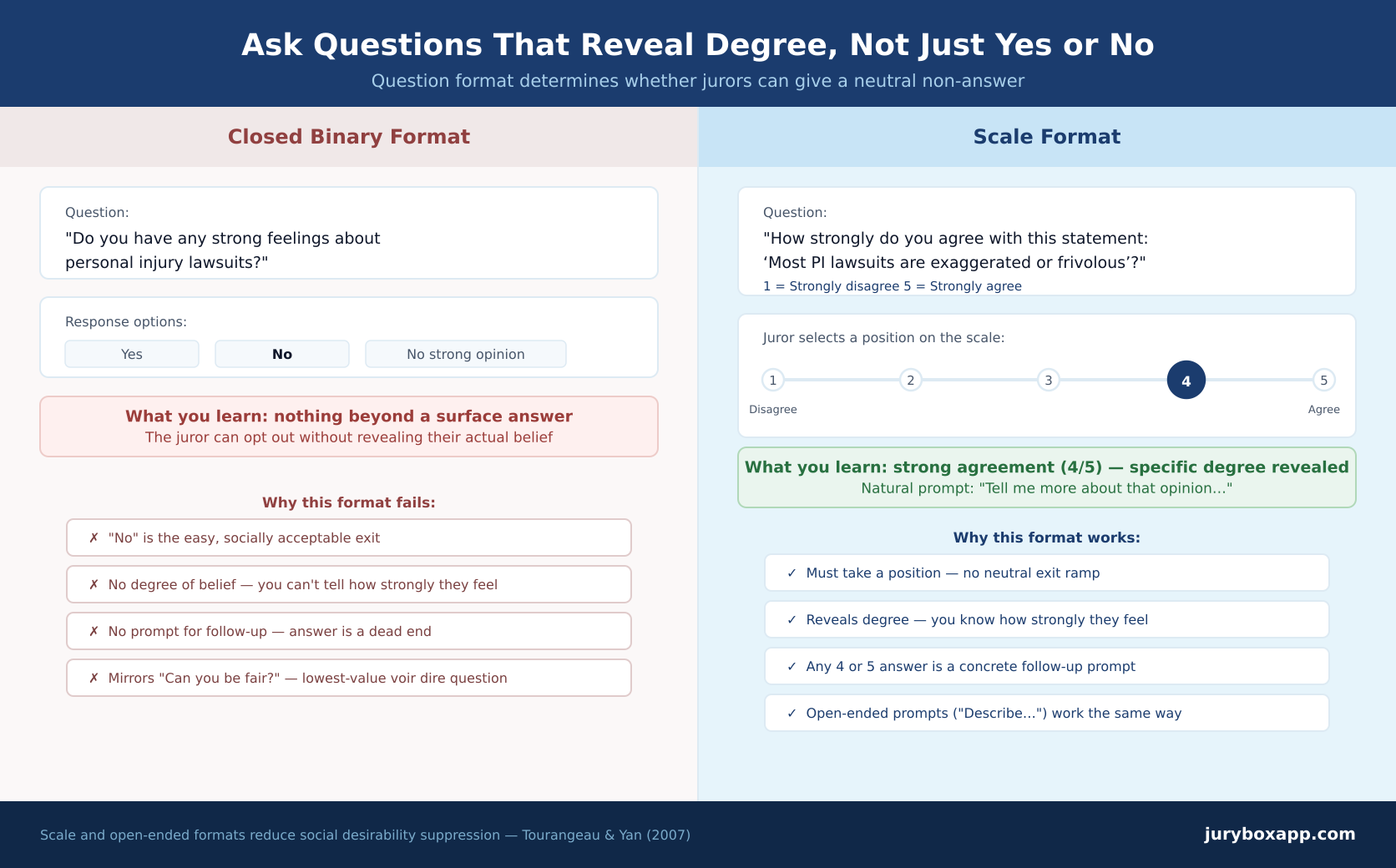
Question design matters. Binary yes/no questions produce the same social desirability suppression that plagues open voir dire. A juror asked "Do you have any strong feelings about personal injury lawsuits?" has an easy exit: "No." A juror asked "On a scale of 1 to 5, how strongly do you agree with the statement 'most personal injury lawsuits are exaggerated or frivolous'?" has to take a position. The scale format reveals the degree of a belief rather than its mere existence, and it is much harder to give a neutral non-answer without actually placing yourself at the neutral midpoint — which is itself informative.
A few principles apply across question categories. Avoid loaded language that telegraphs the correct answer — "Could you fairly evaluate all the evidence presented?" is a closed question with an obvious socially acceptable response. Use neutral, behaviorally specific frames: "Describe any experiences you have had with [topic]" tends to produce more disclosure than "Have you ever had any negative experiences with [topic]?" Leave room for jurors to decline to answer sensitive questions while flagging that they have something to say — "If you prefer not to explain in writing, please indicate that you wish to discuss this privately with the court" preserves the disclosure while protecting the juror.
Avoid questions that jurors cannot honestly answer without specialized knowledge. Asking "Do you understand the burden of proof beyond a reasonable doubt?" invites an automatic "yes" that tells you nothing. Asking "What does the phrase 'beyond a reasonable doubt' mean to you in your own words?" reveals whether their working definition aligns with the standard you need them to apply. This mirrors the principle covered in our guide to voir dire questions: open-ended questions that invite jurors to explain their thinking are far more diagnostic than questions they can answer with a reassuring one-word response.
Managing questionnaire data before trial day
Questionnaire responses are only useful if they are organized before you walk into voir dire. Raw forms stacked in a file box are not a preparation strategy. Build a juror summary sheet — one row per prospective juror, one column per key question area — so you can scan the full panel for red flags without reading every form end to end. Assign each juror a rough tier based on their written answers: for-cause candidate, worth watching closely, or baseline neutral. That tier assignment becomes your initial strike priority ranking and your guide for where to spend oral voir dire time.
The format matters as much as the content. If you have to rifle through a folder to find a juror's form while voir dire is underway, you will miss half of what you prepared. Build your summary in a format you can access quickly — a printed grid, a spreadsheet, or a trial software tool that keeps all of it attached to each juror's digital card so the questionnaire data and real-time notes stay in the same place.
Using questionnaire answers during oral voir dire
The questionnaire's most underused function is not the up-front screening — it is the cross-check against in-court demeanor. Pay attention to gaps. A juror who checked "no prior opinions about the defendant" on the written form but becomes notably animated when the defendant's name is mentioned has told you something. A juror who left the media-exposure question blank but struggles to make eye contact during the preliminary voir dire has possibly also told you something.
When a juror's in-court presentation conflicts with their written answers, the written answers are usually the more reliable data point. Written responses are produced without immediate social pressure and without the juror knowing exactly which answers will keep them on the jury — the same self-administration conditions that, as Tourangeau and Yan (2007) documented, produce more candid disclosure of sensitive information. In-court answers, by contrast, are produced after the juror has observed the courtroom environment, formed an impression of the parties, and — consciously or not — calibrated their responses accordingly; in a related vein, Sommers and Norton (2007) found that people readily generate socially acceptable justifications after the fact. A polished in-court answer is not necessarily the more truthful one. Use the written answer as your anchor and probe the discrepancy explicitly in oral voir dire.
When you probe, frame it as an invitation rather than a challenge. "I noticed you mentioned [X] in your questionnaire — can you tell me more about that?" gives the juror an opportunity to explain and gives you additional information about how they reason. Layering follow-up questions from fact to feeling to case connection applies here just as much as in standard voir dire. The questionnaire is not the end of the inquiry — it is the beginning of a more informed one.
Keeping all of it organized: Jurybox and the questionnaire
The practical challenge with questionnaire data is keeping it connected to everything else you track during voir dire. You go into the courtroom with summary notes, questionnaire-derived tiers, and a strike priority list — and then the jurors start talking, and real-time updates compete with your pretrial preparation for attention. If those two streams live in separate places, something gets lost.
Jurybox lets you pre-load juror questionnaire data before trial begins so your whole team can see each juror's profile from the moment the first name is called. Notes taken during oral voir dire attach to the same card as the pre-loaded questionnaire summary, keeping the picture whole rather than fragmenting across paper, a laptop, and a colleague's annotations. Your strike priority ranking updates in the same place where the questionnaire tier is recorded — no reconciling separate documents at the moment you need to make a challenge decision. The Jurybox how-to guide walks through the full workflow for setting up juror profiles and questionnaire data before trial day.
If your team divides observation responsibilities during voir dire — one attorney watching body language, one tracking who has spoken — that collaboration only works if the information lands in one place. Try Jurybox free for 3 days — no credit card required.
Sources
Tourangeau, R., & Yan, T. (2007). Sensitive questions in surveys. Psychological Bulletin, 133(5), 859–883.
Sommers, S.R. & Norton, M.I. (2007). Race-Based Judgments, Race-Neutral Justifications: Experimental Examination of Peremptory Use and the Batson Challenge Procedure. Law and Human Behavior, 31(3), 261–273.