
Peremptory Challenges: Strategy, Limits, and Best Practices
You walk into voir dire with a finite number of peremptory challenges. Three. Six. Ten. Whatever your jurisdiction allows, the number is small, the strikes only subtract from the panel, and once they are gone they are gone. How you use that budget often shapes the jury you actually try the case to. Peremptory challenge strategy is one of the highest-leverage decisions in a trial — and one of the most commonly made on instinct rather than plan.
What is a peremptory challenge?
A peremptory challenge is the right to strike a prospective juror without stating a reason. It sits alongside the for-cause challenge — which requires a showing that a juror cannot be impartial — and serves a different function. For-cause challenges remove jurors a court agrees should be removed. Peremptories remove jurors you believe will hurt your case even when you cannot articulate a legally sufficient reason.
Although peremptories nominally need no reason, the Equal Protection Clause has progressively narrowed the universe of acceptable reasons. In Batson v. Kentucky, 476 U.S. 79 (1986), the Supreme Court held that prosecutors may not strike jurors on the basis of race. In Edmonson v. Leesville Concrete, 500 U.S. 614 (1991), that protection was extended to civil cases. In J.E.B. v. Alabama ex rel. T.B., 511 U.S. 127 (1994), it was extended to gender. The right to strike without explanation is real, but it is bounded — and the boundaries are not optional.
It is also worth knowing the broader direction of reform. In 2022, Arizona became the first state to eliminate peremptory challenges in both civil and criminal trials. Other states have tightened the standard for sustaining a Batson objection. The peremptory challenge is not going away in most courtrooms tomorrow, but the trend is toward more scrutiny, not less.
How many do you get?
The number varies by jurisdiction and case type. Confirm the count for your specific courtroom — including any standing orders from your judge and any additional challenges for alternates — before you walk into voir dire. Miscounting your strikes during selection is a category of error you cannot recover from.
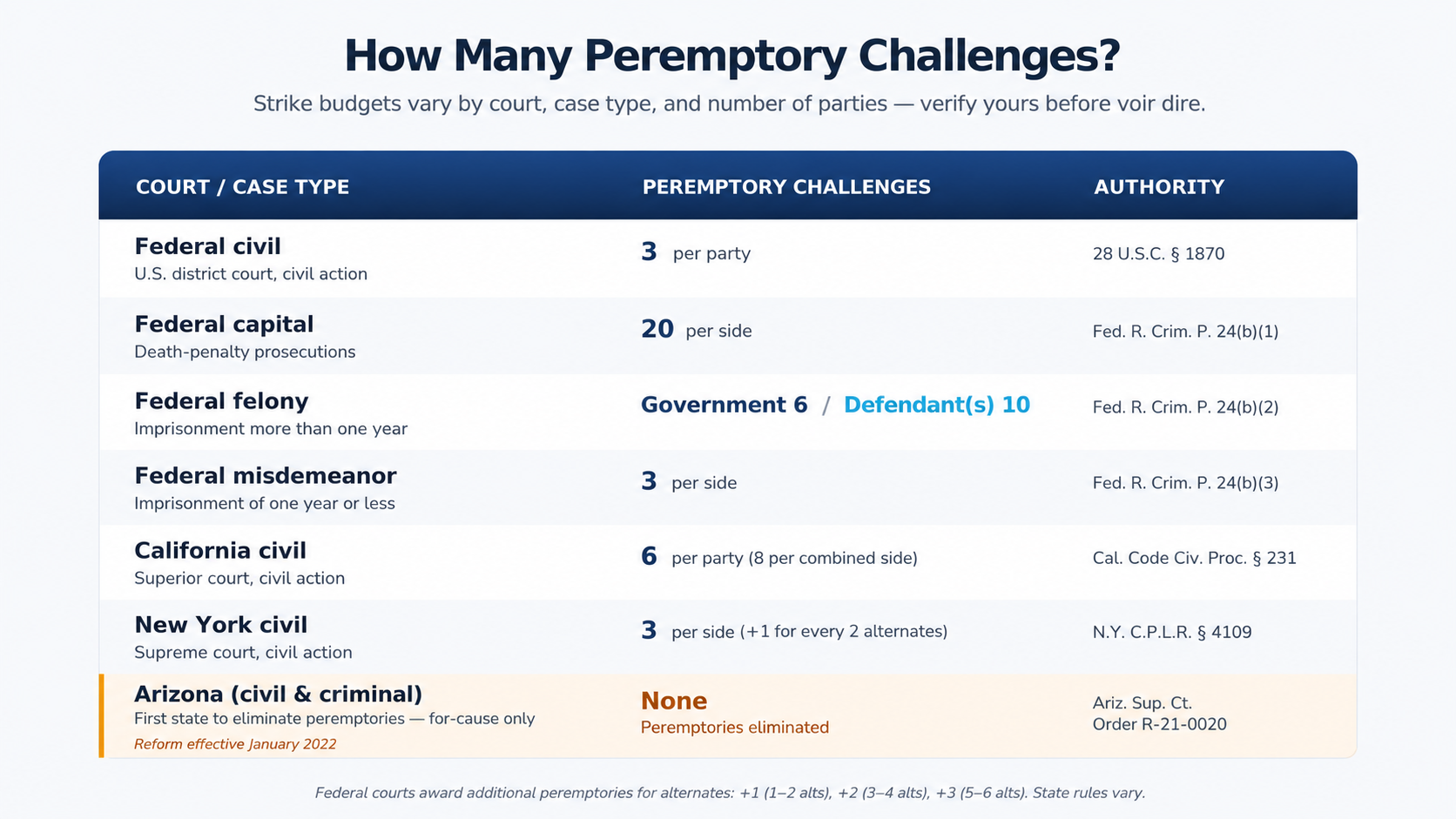
Federal courts also award additional peremptories for alternates: one extra when one or two alternates are seated, two extras for three or four, and three extras for five or six. Most state systems follow a similar pattern but the increments vary. For an authoritative federal overview, see the Congressional Research Service report on Batson and federal peremptory challenge law.
Strikes only subtract: eliminate, do not protect
The most common framing mistake in peremptory strategy is thinking about "protecting" favorable jurors. You cannot. Peremptory challenges are subtractive — you remove jurors from the panel, you do not add or hold any. The strategic question is always whom to remove, never whom to keep.
That framing has consequences. If you walk in with three favorite jurors you want to seat and three jurors you want to strike, your strikes will only address half of that plan. The favorite jurors may still be struck by the other side. What you actually own is the bottom of your list — the jurors you most fear. Budget your strikes against the worst, not the best.
This also means the value of a peremptory is highest when it removes a juror who is both a real threat to your case and unlikely to be struck by the other side. Spending a strike to remove someone the opposing party would have struck anyway is, in effect, throwing the strike away.
Build a strike priority list before voir dire begins
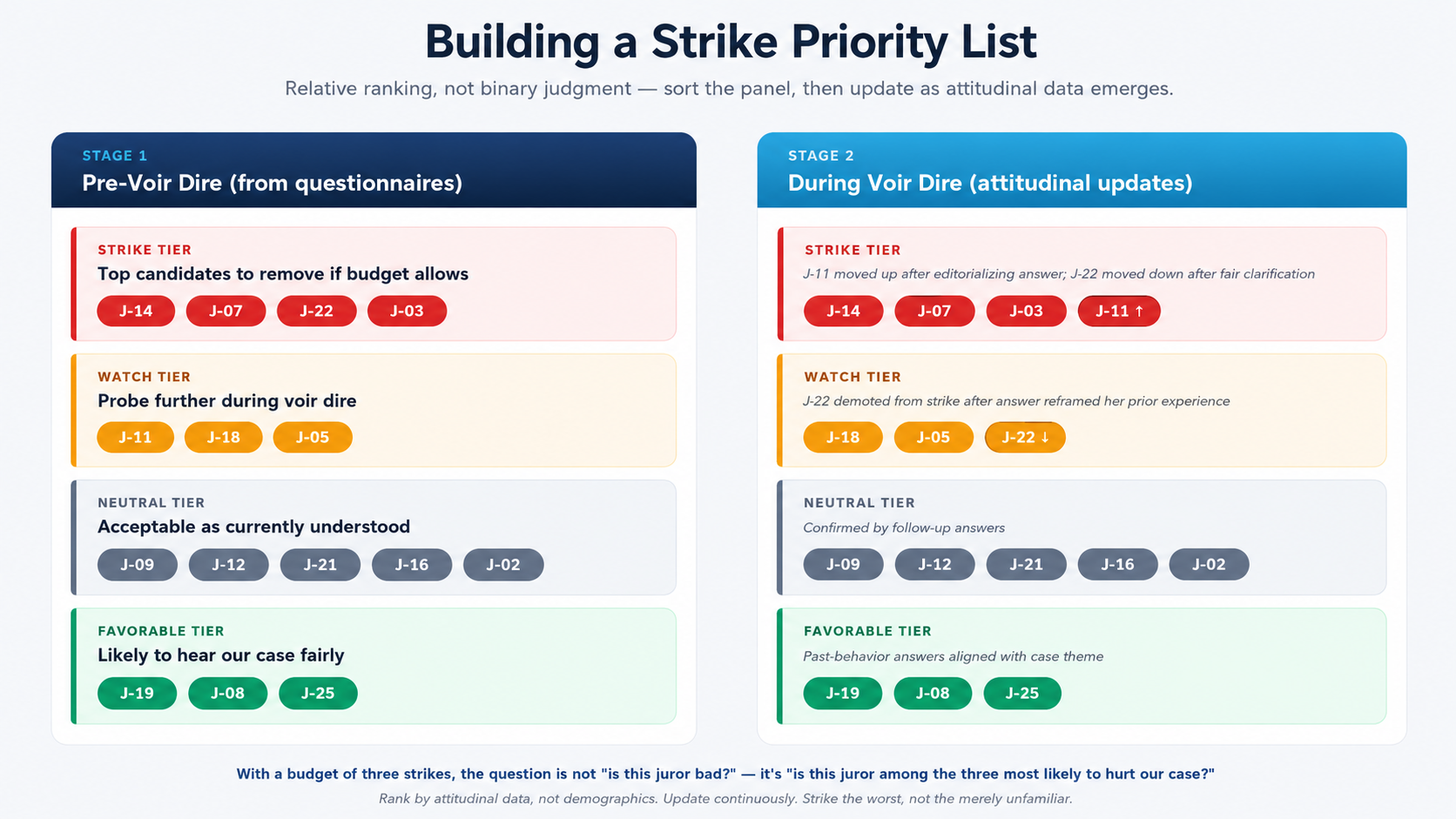
The single most useful preparation step for peremptory strategy is a written priority list. Before voir dire begins, work from whatever pretrial information you have — supplemental juror questionnaires, court-administered questionnaires, the juror list itself — and rank each prospective juror from highest risk to lowest. As voir dire proceeds, update the ranking based on what the jurors actually say and how they say it.
The mechanics matter less than the discipline. Some attorneys use a one-to-five rating scale. Some use a simple sort within tiers (strike candidates, watch list, neutral, favorable). What both approaches share is that they force you to make relative comparisons across the panel rather than binary in-or-out judgments about individual jurors. Relative ranking is what matters: with three strikes, you are not asking "is this juror bad?" — you are asking "is this juror among the three worst I am most likely to lose votes from?"
Your ranking should be driven by attitudinal data, not surface characteristics. As covered in our post on identifying juror bias, demographic shortcuts produce weak and case-specific predictions. The jurors who hurt you are the ones whose past experiences, expressed beliefs, and patterns of reasoning suggest they will resist your evidence. Those are the data points that belong on a strike priority list.
Batson compliance is not a checkbox
Every strike you make can, in principle, be challenged under Batson. The framework is a three-step burden-shifting analysis: (1) the objecting party makes a prima facie showing that the strike was based on a protected class; (2) the striking party offers a race-neutral (or gender-neutral) explanation; and (3) the court determines whether the explanation is genuine or pretextual. Prepare for every step, not just the second.
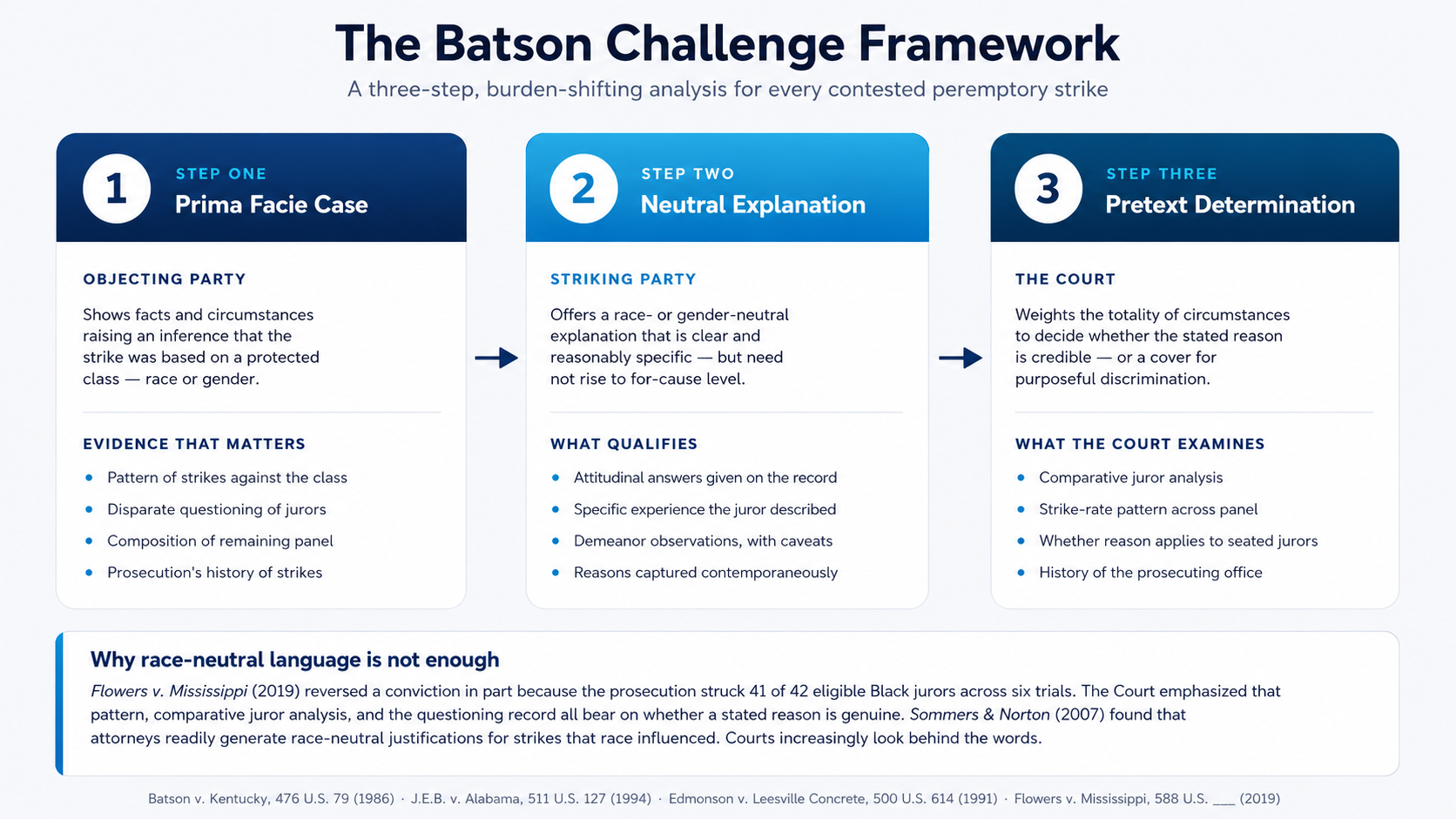
The most important practical implication of step three is that a stated reason on its face is not enough. In Flowers v. Mississippi, 588 U.S. ___ (2019), the Supreme Court reversed a conviction in part because, across six trials of the same defendant, the prosecution used peremptory strikes against 41 of 42 eligible Black prospective jurors. The Court emphasized that the totality of the circumstances — including the pattern of strikes, comparative juror analysis, and the questioning record — bears on whether a race-neutral explanation is credible. Pattern matters. Pretext can be inferred.
That conclusion is reinforced empirically. Sommers and Norton (2007) found that prospective jurors' race influenced peremptory use across samples of college students, law students, and practicing attorneys — but that participants almost always justified those strikes in race-neutral terms. Race-neutral language is easy to generate; it is not, by itself, evidence that race was not in play. Courts increasingly look behind the words.
The practical preparation is straightforward. For every juror on your strike list, build a contemporaneous record of attitudinal reasons — answers they gave, experiences they described, beliefs they expressed — that would justify the strike if challenged. Capture these reasons during voir dire, not reconstructed afterward. A juror's specific statement at the time the strike is contemplated is more durable than a reason you have to remember an hour later. Avoid reasons that, examined against the record, apply equally to jurors you accepted — comparative juror analysis is one of the most common ways pretext is established.
Common strategic mistakes
Spending strikes on neutral jurors. When the panel feels uncomfortable, attorneys reach for a strike to relieve the tension. A neutral juror is not a bad juror. With a budget of three or six, every strike you spend on someone you merely don't love is a strike you do not have for someone who genuinely threatens your case.
Relying on demographic assumptions. Striking a juror because of their profession, age, or zip code rather than what they actually said is both strategically weak and a recurring source of Batson exposure. As discussed in the voir dire questions post, attitudinal data drawn from past behavior is a far stronger predictor than demographic category. Make the strike about something the juror said.
Impulsive strikes. Strikes made on instinct, without consulting your priority list or your co-counsel, are the strikes most likely to be later regretted. The discipline of pausing — even for a few seconds — to compare a contemplated strike against your written ranking prevents the most expensive errors.
Losing count. In the rhythm of voir dire, it is surprisingly easy to lose track of how many strikes each side has used, particularly when the procedure alternates between for-cause and peremptory challenges. Miscounting is unforced error: you either pass on a strike you could have used or attempt one you no longer have.
Tracking strikes in real time
The administrative side of peremptory strategy is undersold. You need to track, in real time and accurately, how many strikes each side has used, on whom, and for what stated reason. You need to know exactly how many you have left. And in a Batson context, you need to be able to produce the reasons in the same order they were formed — not reconstructed after the fact.
Paper systems can do this when one person's job is to keep the strike sheet and nothing else. The difficulty is that during voir dire, no one on a trial team has only that job. Lead counsel is asking questions, co-counsel is taking attitudinal notes, the paralegal is queuing the next juror file — and the strike count is the thing that drops first when the panel moves quickly. The cost of a miscount is not abstract: it can be a wasted appellate issue or a juror seated you did not intend to seat.
Tracking peremptory strategy with Jurybox
Jurybox is designed for this part of the trial. The application tracks for-cause and peremptory challenges automatically by side and case type, surfaces the remaining strike count, and lets you record the reason for each strike on the juror's card as it is exercised — so the contemporaneous record exists if you ever need it for a Batson response. Pre-trial juror ratings move with you into voir dire, so your strike priority list is the same document you are working from in court, not a separate sheet of paper passed between co-counsel. See how it works in the Jurybox how-to guide.
A small number of strikes, used well, is one of the highest-leverage decisions a trial attorney makes. The work is mostly preparation, ranking, and disciplined real-time tracking — and most of the common mistakes are mechanical rather than tactical. Build the priority list, defend every strike on the record as you make it, and never lose count. Try Jurybox free for 3 days — no credit card required.
Sources
U.S. Supreme Court. (1986). Batson v. Kentucky, 476 U.S. 79. Cornell Legal Information Institute.
U.S. Supreme Court. (1991). Edmonson v. Leesville Concrete Co., 500 U.S. 614. Cornell Legal Information Institute.
U.S. Supreme Court. (1994). J.E.B. v. Alabama ex rel. T.B., 511 U.S. 127. Cornell Legal Information Institute.
U.S. Supreme Court. (2019). Flowers v. Mississippi, 588 U.S. ___ (slip op.).
Sommers, S.R. & Norton, M.I. (2007). Race-Based Judgments, Race-Neutral Justifications: Experimental Examination of Peremptory Use and the Batson Challenge Procedure. Law and Human Behavior, 31(3), 261–273.
Congressional Research Service. (2022). Batson v. Kentucky and Federal Peremptory Challenge Law (Report No. R47259).
Arizona State Law Journal. (2022). Arizona Eliminates Peremptory Challenges.
Federal Rules of Criminal Procedure. Rule 24: Trial Jurors. Cornell Legal Information Institute.
28 U.S.C. § 1870: Challenges (civil). Cornell Legal Information Institute.