
How to Identify Juror Bias During Jury Selection
Attorneys lose cases to juror bias they never saw coming. Not because the bias was hidden — but because they were looking for the wrong things. They screened for demographic proxies and obvious conflicts of interest, and missed the subtler attitudes that actually drove the verdict. Identifying bias during voir dire requires a more systematic approach than most attorneys practice.
The three types of juror bias you need to understand
Juror bias is not a single thing. Researchers distinguish between at least three distinct forms, each of which requires different detection strategies.
Explicit bias is conscious and often openly held. A juror who believes police officers always tell the truth, or that civil plaintiffs are motivated by greed, may be willing to say so directly if asked the right questions. Explicit bias is the easiest to surface — but only if you ask direct, open-ended questions that give jurors permission to be honest.
Implicit bias is unconscious. The juror genuinely does not believe they are biased, but their automatic associations and reactions will shape how they process evidence. Implicit bias affects perception, memory, and judgment in ways the person experiencing it cannot fully observe. You cannot ask a juror to disclose implicit bias because they do not know they have it. You detect it indirectly — through patterns in their answers, their body language, and the experiences they describe.
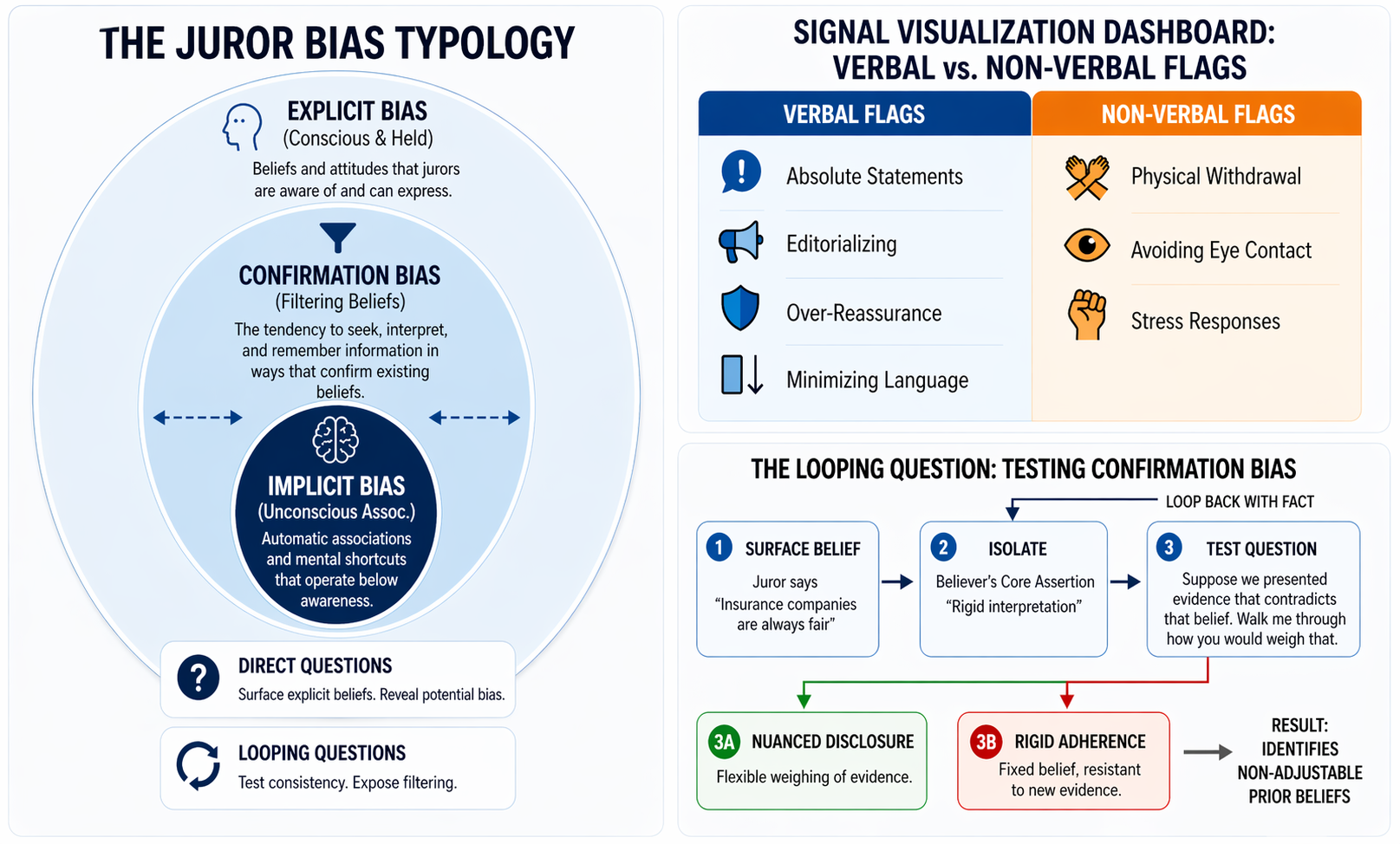
HIW Test Question ("Hypothetically, If We..."): The loop-back step where you present a specific, challenging hypothetical directly against the juror's stated belief — for example, "Suppose we presented evidence that the company had internally flagged this risk before the accident. Walk me through how you would weigh that, given what you've just told me." Most jurors will claim they can be fair in the abstract; the HIW question forces a reaction to a concrete scenario. A juror who responds with rigid adherence ("My mind would already be made up") has effectively identified themselves as a high-risk strike target.
Confirmation bias is the tendency to seek and favor information that confirms existing beliefs while discounting contradictory evidence. Every juror has it to some degree. The question during voir dire is whether a particular juror's priors are so strongly aligned against your case that confirmation bias will prevent them from fairly weighing your evidence. The best proxy is asking jurors about analogous past experiences and how strongly they interpreted those experiences.
The most useful technique for testing confirmation bias directly is the looping question: take the juror's stated belief and loop it back against the facts of your case. "Given what you've said about how you view corporate defendants, suppose we presented evidence that the company had internally flagged this safety risk two years before the accident. Walk me through how that evidence would sit with you." A juror who cannot even entertain the counter-narrative during voir dire will not do so during deliberations. That answer tells you something a simple "can you be fair?" never could.
Why demographics fail as a bias detector
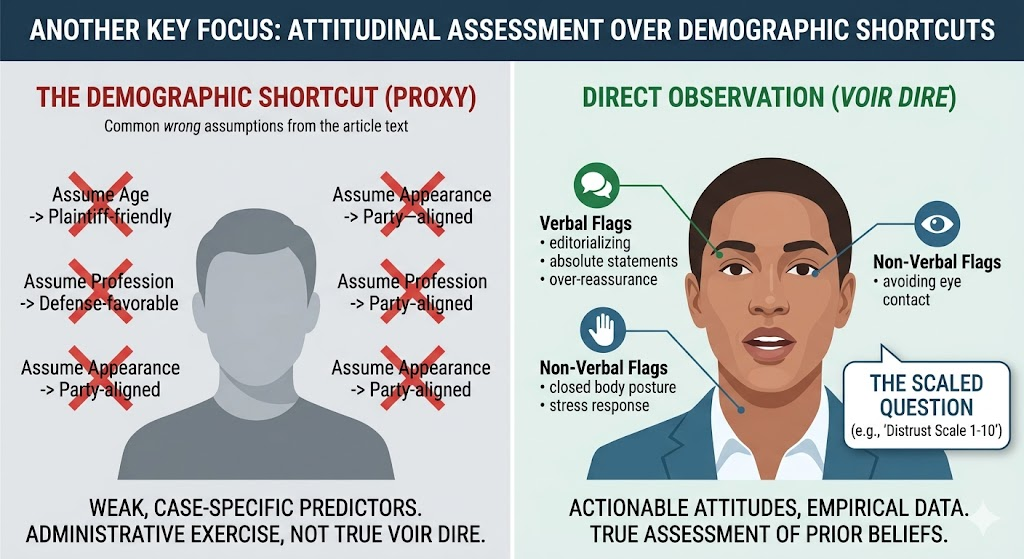
Many attorneys still rely heavily on demographic shortcuts: assume this age group will be plaintiff-friendly, assume this profession will be defense-favorable, strike people who look like the opposing party. This approach has two serious problems.
First, it is often wrong. The empirical evidence for demographic-based jury predictions is weak and highly case-specific. Demographic categories are too broad to predict individual attitudes reliably. A juror's occupation tells you almost nothing about their view of punitive damages. Their zip code tells you almost nothing about whether they distrust your key witness.
Second, relying on demographics means you are not actually doing voir dire — you are conducting an administrative exercise with predetermined outcomes. You are using up your peremptory challenges on the basis of pattern-matching rather than direct observation. The jurors most likely to hurt you are often the ones whose surface characteristics look neutral.
Demographics can serve as a rough starting point for generating hypotheses about which topics to probe. They should never be the conclusion.
Verbal signals of bias
What jurors say — and how they say it — is your primary data source during voir dire. Several patterns reliably indicate bias worth probing further.
Absolute statements about groups: When a juror says things like "people always…" or "those types of cases are usually just…" they are revealing categorical thinking. The target of the category matters less than the rigidity of the belief. Categorical thinkers are more likely to apply their priors heavily and resist nuanced evidence.
Unasked-for editorializing: When answering a factual question, a biased juror will often volunteer their opinion. "Yes, I was in a car accident — and I can tell you the insurance company was completely in the right" was not what you asked. That editorializing reveals a strong prior attitude that the juror did not even recognize they were expressing.
Overly reassuring answers: "I can absolutely be completely fair" delivered immediately and with great confidence is more suspicious than a thoughtful "I'll do my best." Jurors who have actually examined their own possible biases tend to answer with more uncertainty. Confident blanket assurances are often a social performance, not genuine self-assessment.
Minimizing language: Phrases like "it's not a big deal," "I don't really have strong feelings about it," or "that was a long time ago" can signal that a juror is downplaying something significant. Follow up on minimizing language — ask them to walk you through what actually happened.
| Signal | What it sounds like | What it reveals |
|---|---|---|
| Absolute statements | "People always sue just for money." | Rigid, categorical thinking |
| Unasked-for editorializing | "I had a claim once — the whole thing was a scam." | Strong prior negative experience |
| Over-reassurance | "I can definitely be 100% completely fair." | Social desirability bias; unexamined priors |
| Minimizing language | "It was a long time ago, not really a big deal." | Downplaying a formative experience |
Non-verbal signals worth noting
Non-verbal behavior is harder to read reliably, and you should be cautious about over-interpreting it. Body language is not a truth-detection system. That said, certain patterns correlate with discomfort, evasion, or strong emotional reactions that are worth probing verbally.
Sudden physical withdrawal: Leaning back, crossing arms, or turning slightly away when a topic is introduced can signal a defensive reaction. This is most meaningful when it is a clear change from the juror's prior baseline — if they were engaged and relaxed and they suddenly close up when you mention expert witnesses, that shift is information.
Avoiding eye contact on specific topics: A juror who maintains normal eye contact throughout voir dire but looks away or down when certain subject matter comes up may have a reaction to that topic they are not voicing. It is not conclusive, but it is a prompt to ask a follow-up question.
Visible stress responses: Jaw tightening, fidgeting, or changes in breathing rate when specific topics arise can indicate emotional loading. Again, these are hypotheses to test verbally, not conclusions.
The value of non-verbal observation is not that it tells you what a juror thinks — it tells you where to probe further. Treat non-verbal signals as flags, not findings.
A critical caution: relying heavily on body language to make challenge decisions — without verbal corroboration — crosses into unreliable territory. Psychologists have found that humans perform near chance levels at detecting deception from non-verbal behavior alone, and attorneys are no exception. A challenge based primarily on a juror's posture or eye contact, rather than on what they actually said, is a challenge built on a gut feeling dressed up as observation. Use non-verbal cues to generate follow-up questions — not to justify strikes you have already decided on.
Follow-up techniques that surface concealed bias
Most of the bias that damages trials is not volunteered during voir dire. It surfaces — or doesn't — depending on how you follow up when a juror gives you an ambiguous or incomplete answer.
The normalization technique: Before asking about a sensitive attitude, normalize the existence of that attitude. "Some people who've dealt with insurance companies come away feeling like they were treated unfairly. Others felt the process was straightforward. Tell me about any experience you've had with an insurance company — what happened and how it left you feeling." Framing the question this way signals that either answer is acceptable and reduces the social pressure to give the "right" answer.
The third-person probe: When a juror seems reluctant to own an attitude directly, ask them about people they know. "Tell me about friends or family members who've had strong opinions about cases like this one — what they've shared with you and how that sits with you." Jurors will often describe other people's views that are actually their own, with slightly less defensiveness.
The commitment test: After a juror gives you a reassuring answer, test whether it holds. "You mentioned you could set aside what happened to you. Let me ask it this way — put yourself in the shoes of the attorney on the other side and describe how you'd feel about having someone with your background on this jury." The hypothetical role reversal makes the juror think differently and sometimes produces a more honest answer.
The silence technique: After a juror finishes an answer, pause before you move on. Many jurors will fill the silence with additional information — often the more candid part of their answer. Silence signals that you are still listening and that more is welcome.
The scaled question: Binary questions — "are you biased against corporations?" — invite equally binary answers. A scale forces more honest, nuanced disclosure. "On a scale of one to ten, where one is complete distrust and ten is complete trust, where would you put large corporations today?" Most jurors will not say ten, and the number they give you opens a genuine conversation. "That's interesting — tell me what's behind that number." Scaled questions are especially useful on loaded topics where a direct yes/no question produces a social-performance answer.
Social media research: what's permissible and what isn't
Pre-trial investigation of jurors through publicly available social media has become standard practice. Done carefully, it can reveal publicly stated opinions, professional backgrounds, organizational affiliations, and prior statements about topics central to your case. Done carelessly, it creates ethical and legal exposure.
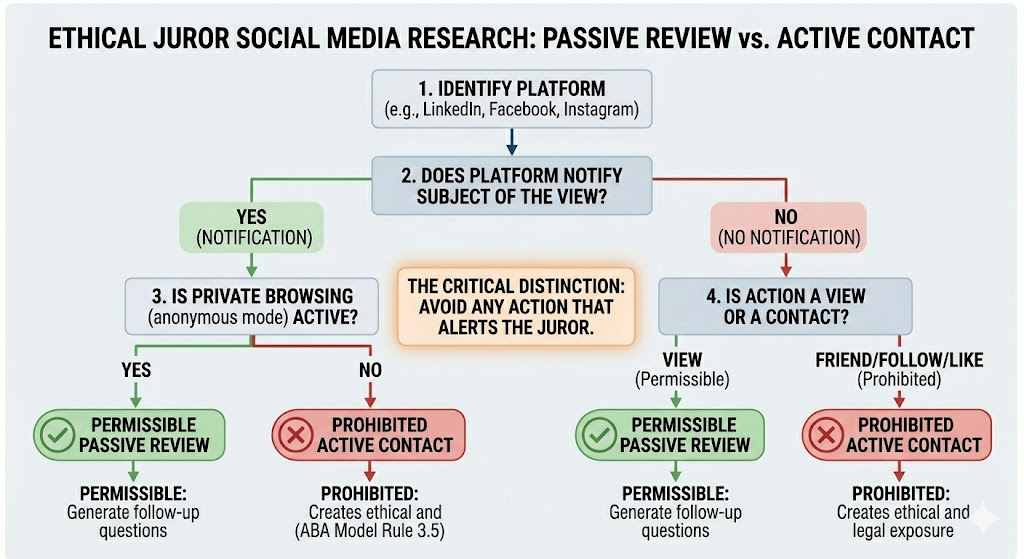
The key distinction is between passive review and active contact. ABA Model Rule 3.5 prohibits ex parte communication with jurors, and most state bar opinions extend this prohibition to social media contacts that would notify the juror that they are being investigated — including sending a friend or follow request, or viewing a profile in a way that generates a visible notification. Passively viewing a public profile is generally permissible; any action that alerts the juror to your investigation is not.
Platform mechanics matter here. LinkedIn notifies users when someone views their profile unless the viewer has switched to private browsing mode first — a detail that paralegals and junior associates doing pre-trial research frequently overlook. Facebook and Instagram may similarly signal interest through follow requests, suggested connections, or notification algorithms. Before delegating social media research to a team member, make sure they understand which actions on each platform are visible to the subject and which are not. The same principle applies to any tool — including third-party jury research services — that pulls data in ways that could generate notifications.
Even where social media research is permissible, use the findings carefully. A juror's public posts from three years ago are a data point, not a verdict. Use them to generate better questions during voir dire — not to substitute for direct observation of the person in front of you. Courts have also become more likely to ask jurors whether they were researched, and how you obtained information may come under scrutiny if it later becomes an issue.
Check your jurisdiction's specific rules and any standing orders in your courthouse. Rules around juror social media research are still evolving, and local requirements vary.
Keeping track of what you're observing
In a panel of twenty-five jurors, you are gathering verbal answers, non-verbal observations, and follow-up impressions for each person — simultaneously managing your questioning strategy, watching the clock, and coordinating with co-counsel. The jurors who show subtle bias signals are exactly the ones who will blur together in your notes if you aren't organized.
Jurybox lets you and your co-counsel take notes on each juror simultaneously in real time, so one attorney can be asking questions while the other is capturing observations. You can flag jurors who warrant a follow-up question, rate them as the voir dire progresses, and enter notes on each bias signal as you observe it — so when you reach your challenge decisions you are working from a complete picture of every juror rather than end-of-session memory. See how it works in the Jurybox how-to guide.
Bias that goes undetected in voir dire does not disappear — it shows up in deliberations. The work you do in those few minutes identifying the jurors who cannot fairly hear your case is among the highest-leverage preparation in a trial. Try Jurybox free for 3 days — no credit card required.
Sources
Greenwald, A.G. & Banaji, M.R. (1995). Implicit social cognition: Attitudes, self-esteem, and stereotypes. Psychological Review, 102(1), 4–27.
The Learning and Implicit Processes Lab. (2019). What Is Implicit Bias? Psychology Today.
Sommers, S.R. & Norton, M.I. (2007). Race-Based Judgments, Race-Neutral Justifications: Experimental Examination of Peremptory Use and the Batson Challenge Procedure. Law and Human Behavior, 31(3), 261–273.
American Bar Association. Model Rule 3.5: Impartiality and Decorum of the Tribunal. Model Rules of Professional Conduct.
American Psychological Association. (2016, March). Deception Detection. APA Monitor on Psychology.