
What Questions Should You Ask During Voir Dire?
Jury selection is the only phase of trial where you can have a real conversation with the people who will decide your case. Your opening statement, your witnesses, your closing argument — none of it happens in dialogue. Voir dire does. The questions you ask in those few minutes can reveal who will champion your case in deliberations and who will quietly undermine it. Getting them right matters more than most attorneys realize.
The real goal of voir dire questioning
Most attorneys think about voir dire as elimination — finding unfavorable jurors and striking them from the panel. That framing leads to the wrong kinds of questions. The actual goal is to understand who these people are: their attitudes, life experiences, and the lens through which they will hear your case.
Social psychologists have shown that jurors form preliminary narratives about a case early — often before the first witness is called. The attitudes and expectations that shape those narratives begin forming during voir dire. You are not just screening for obvious bias. You are getting a window into how each person is likely to process everything that follows.
Ask open-ended questions
The single most common mistake in voir dire is asking questions that can be answered with "yes" or "no." Questions like "Can you be fair?" tell you nothing. Every juror will say yes. You want questions that require a juror to actually think and talk.
Start your questions with: Tell me about..., Describe..., Walk me through..., How did you feel when..., or What was that experience like for you? These prompts force jurors to reveal something real about themselves rather than giving you an aspirational answer about how they hope they would behave.
Ask about past behavior, not hypotheticals
A juror who says "I would absolutely follow the law on damages" is telling you what they think you want to hear. A juror who describes a time they felt a civil lawsuit was frivolous is showing you something true about how they think.
The most reliable predictor of how a juror will behave is how they have behaved in analogous situations in the past. If your case involves a large damages award, ask jurors about times they have evaluated compensation or fairness in their own lives. If it involves expert testimony, ask about their general trust in professional expertise. You are looking for patterns of attitude, not promises of impartiality.
Categories of questions to cover
A strong voir dire covers several distinct areas. Not every case requires every category, but you should have questions ready in each bucket and know which ones matter most for your specific facts.
Prior legal experience: Has this person been a party in a lawsuit — as plaintiff, defendant, or witness? Have they or someone close to them been involved in a situation similar to the facts of your case? Prior experiences with the legal system are among the strongest predictors of how a juror will approach yours.
Relevant personal history: In a personal injury case, ask about prior injuries, medical treatment, and interactions with insurance companies. In a criminal case, ask about prior contact with law enforcement. The goal is not to expose someone but to understand the frame through which they will hear your evidence.
Media exposure and pre-trial opinion: Have they seen, heard, or read anything about this case? Do they have strong feelings about cases of this type in general? This is especially important in high-profile matters but worth asking in every trial.
Beliefs about burden of proof and damages: Many jurors come in with deeply held beliefs — that the plaintiff must have done something wrong to get sued, that large verdicts are irresponsible, that money can never truly compensate for injury. These beliefs will not disappear during trial. Surface them early.
Layer your questions
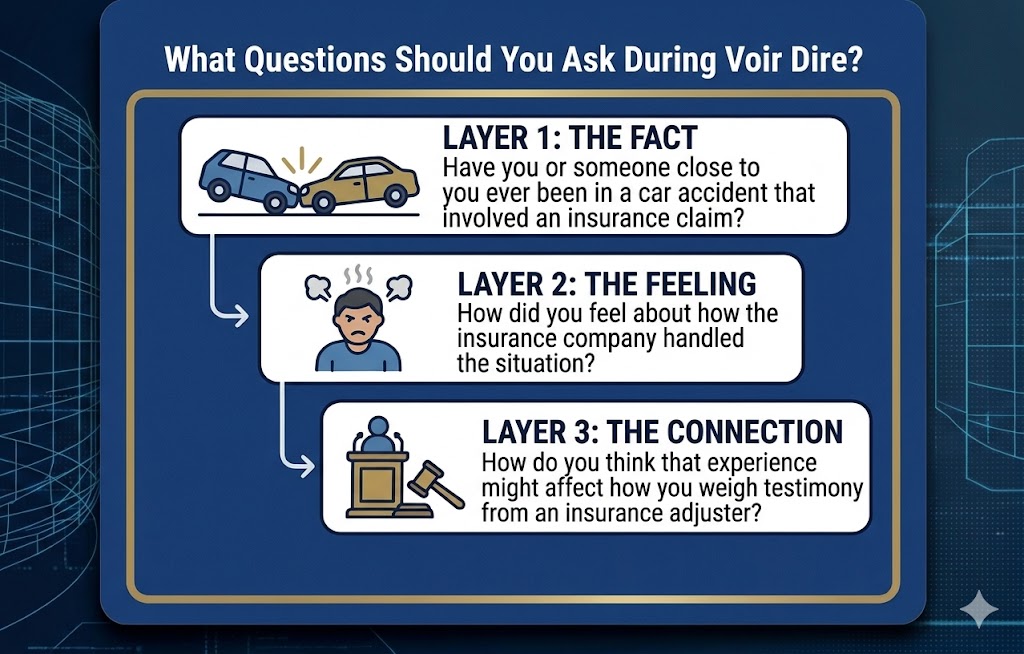
One follow-up question is rarely enough. When a juror reveals something interesting, keep going. A useful technique is to layer your questions: first ask what happened, then ask how they felt about it, then ask how that experience might affect their thinking in a case like this. For example, in a case involving an insurance dispute:
Layer 1 — The fact: "Have you or someone close to you ever been in a car accident that involved an insurance claim?"
Layer 2 — The feeling: "How did you feel about how the insurance company handled the situation?"
Layer 3 — The connection: "How do you think that experience might affect how you weigh testimony from an insurance adjuster in this case?"
The phrase "tell me more" is one of the most valuable tools in voir dire. When a juror gives you a partial or guarded answer, it signals that there is more to the story. "Tell me more about that" invites them to continue without making them feel cross-examined.
Let jurors do the talking
Where your judge and jurisdiction permit open-ended attorney questioning, a good rule of thumb is that jurors should be doing most of the talking. The point is for them to reveal themselves — not for you to present your case, educate them on the law, or demonstrate how reasonable you are. Attorneys who dominate voir dire miss what they need to know and often irritate the panel in the process. (In judge-led voir dire, your role shifts to supplemental follow-up questions — these principles still apply to whatever time you are given.)
Once a juror begins to speak honestly, your job is mostly to listen and probe. Nod. Ask follow-up questions. Let silences breathe when the room allows it. One candid juror can prompt others to open up and model honest answers for the group — silence in voir dire is not neutrality, it is information you have not yet uncovered.
Questions you should avoid
"Can you be fair?" Almost every juror will say yes regardless of how they actually feel. It tells you nothing and wastes your time.
Leading questions designed to commit jurors to your side. Questions like "You'd agree that money can compensate for pain, right?" come across as manipulative, put jurors on guard, and produce meaningless agreements. Jurors who are watching you try to influence them are less likely to tell you the truth.
Legal jargon without explanation. Terms like "preponderance of the evidence" or "proximate cause" can confuse jurors and cause them to shut down rather than engage. If you need to introduce a legal concept, take a moment to explain it in plain language first.
Questions that promise specific outcomes. Asking a juror to commit to awarding damages before they have heard any evidence is improper and will likely draw an objection. Keep your voir dire questions diagnostic rather than persuasive.
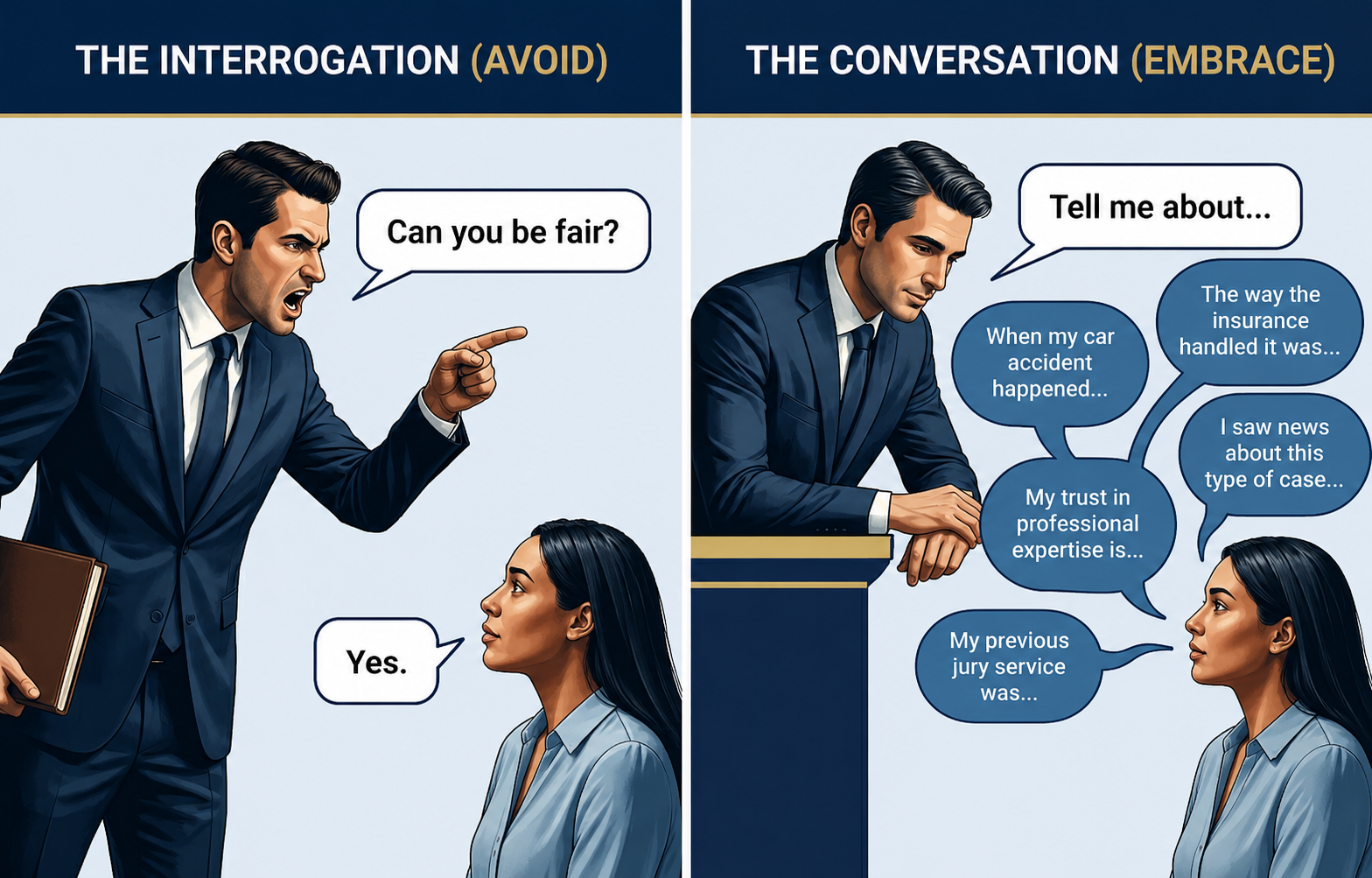
Make it a conversation, not an interrogation
Jurors who feel interrogated will give you defensive, curated answers. Jurors who feel heard will give you honest ones. The atmosphere you create matters as much as the questions you ask. Introduce yourself. Acknowledge that this process can feel awkward. Use the jurors' names. If someone gives you a candid answer, thank them sincerely — it signals to the entire panel that honesty is welcome here.
Remember that jurors are also evaluating you. The party whose attorney comes across as more human and trustworthy during voir dire starts trial with an advantage. The questions you ask and how you ask them are your first impression.
Keeping track in real time
Voir dire moves fast. You are asking questions, reading body language, listening to answers, and thinking about follow-up questions — all at the same time. The notes you take on each juror during this process become the basis for every challenge decision you make. If those notes are scattered across a legal pad or passed between co-counsel on paper, you are going to miss things.
Jurybox is built specifically for this problem. You and your co-counsel can take notes on each juror simultaneously in real time — no papers to pass, no whispered consultations. When you are working through the layering technique, you can capture each layer of a juror's response on their card as you go, so by the time you are making strike decisions you have the full picture rather than fragments. You can even pre-load juror questionnaire data before the first name is called so all your background information is already in the system when voir dire begins. See how it works in the Jurybox how-to guide.
Going into your challenge decisions with organized, complete notes on every juror is one of the most practical edges you can build in a trial. Try Jurybox free for 3 days — no credit card required.
Sources
Pennington, N. & Hastie, R. (1991). A Cognitive Theory of Juror Decision Making: The Story Model. Cardozo Law Review, 13(2–3), 519–557.
Franklin, K. (2013). The Best Predictor of Future Behavior Is … Past Behavior. Psychology Today.
Giles, Hon. L.E. (2016). Honest Answers: Learning How Best To Phrase Questions To Prospective Jurors in Voir Dire. Boston Bar Journal.