
Do You Need a Jury Consultant? A Practical Guide for Trial Attorneys
A jury consultant can cost a few thousand dollars for a half-day of voir dire help or well into seven figures for a firm that joins the case early and stays through verdict. That spread is the whole problem. The question is rarely "is a consultant useful?" — competent consultants are genuinely useful — but "is a consultant worth it on this case, against what is actually at stake?" This is a proportionality decision, and it is one you can make deliberately rather than by default.
What you're actually paying for: a consultant's real value is empirical research — mock trials and focus groups — not a reliable way to pick "the right" jurors. Scientific jury selection only beats experienced judgment when juror traits strongly predict the verdict.
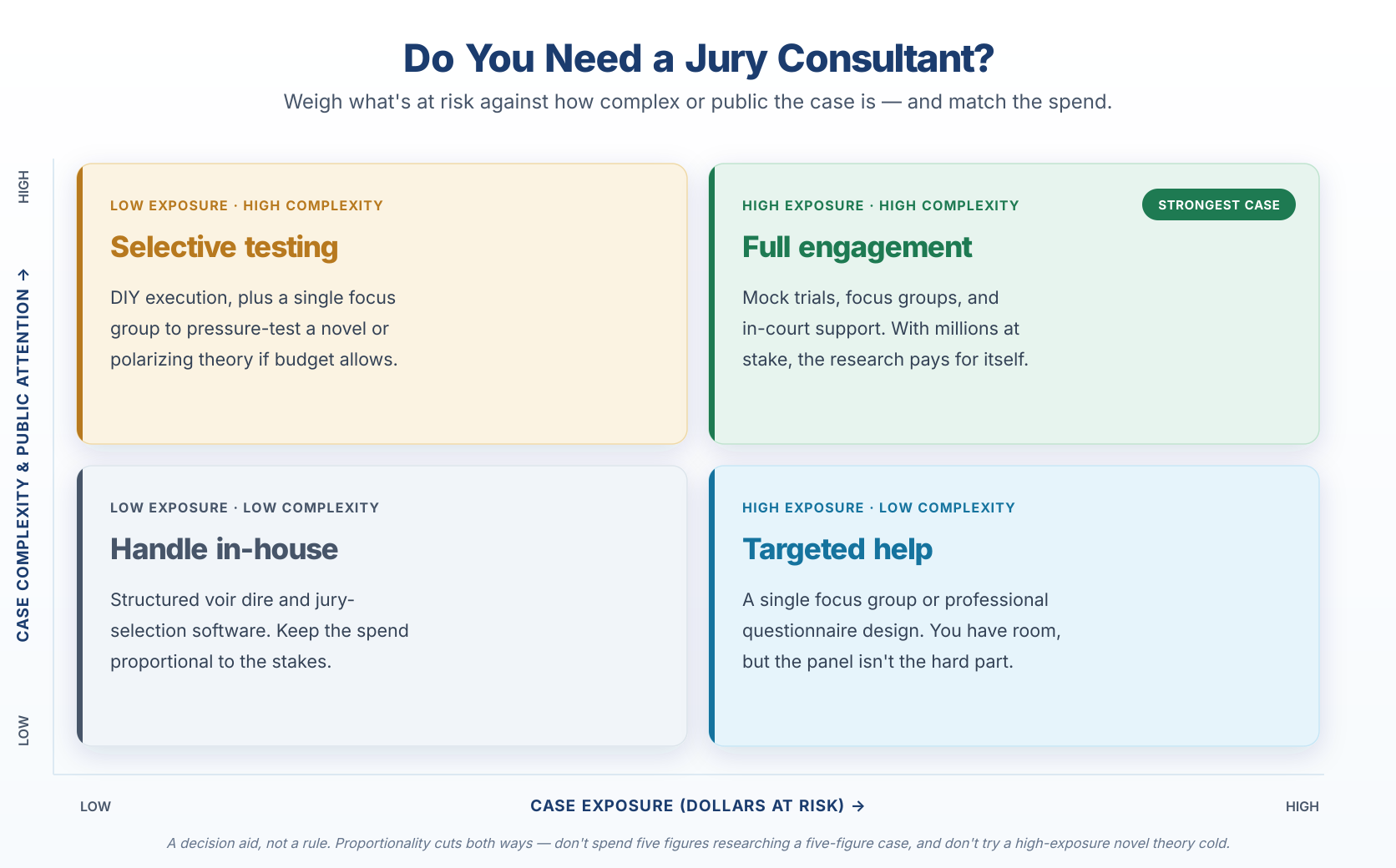
When it's worth it: high exposure paired with complexity, heavy media attention, or a novel and polarizing case. For routine, lower-stakes matters, fees can rival the verdict — usually a skip.
The middle ground: much of the in-court payoff is execution — organized notes, team collaboration, accurate challenge counts — which you can do yourself, and which jury-selection software handles for a fraction of consultant cost.
Want the middle-ground tooling? Try Jurybox free for 3 days — no credit card required.
What does a jury consultant actually do?
"Jury consultant" covers a wider range of work than the in-court juror-picking the term suggests. Most of the value is produced before trial. A typical engagement can include any combination of the following:
Case-material review and theme development — reading the file and helping shape the narrative the panel will hear.
Voir dire question and supplemental-questionnaire design — drafting the questions and the written instrument used to surface attitudes.
Mock trials and focus groups — testing arguments, witnesses, demonstratives, and damages ranges against jury-eligible residents of the venue before the real trial.
In-court voir dire assistance — observing venire members and advising on the use of for-cause and peremptory challenges.
Shadow juries — recruited observers who watch the trial and report reactions during breaks so counsel can adjust in real time.
Juror social media and background research — passive review of public information, subject to the ethical limits discussed in our post on identifying juror bias.
Post-verdict juror interviews — learning what actually moved the jury after the case is over.
The in-court selection assistance is the most visible piece, but for most cases the research products — mock trials and focus groups — are where consultants earn their fee. They give you data about how strangers react to your case that you cannot get any other way.
Does scientific jury selection actually work?
Before spending on a consultant primarily to pick the jury, it is worth being honest about what the research shows. The academic verdict on "scientific jury selection" — using survey and social-science methods to predict how individual jurors will vote — is mixed. In a review of three decades of research, Lieberman (2011) concluded that the utility of scientific jury selection remains "still murky", in large part because methodological limits make clean conclusions hard to draw. Where it helps, it helps most in cases in which juror characteristics are strongly tied to the verdict; where that link is weak, it adds little over experienced attorney judgment.
The reason matters for how you spend. Predicting an individual juror's vote is hard because the best predictors are not the easy-to-see ones. Pre-existing, case-relevant attitudes predict verdicts better than life experiences, and experiences predict better than demographics. As covered in our post on identifying juror bias, demographic shortcuts are weak, case-specific predictors — a point supported by Sommers and Norton (2007). A consultant who builds a profile from attitudes drawn out in a thoughtful questionnaire is doing something defensible. A consultant — or an attorney — who strikes on demographic stereotypes is not.
None of this means consultants are not worth hiring. It means the strongest case for one is usually the research — pressure-testing your themes and evidence against real people — rather than a promise to identify the "right" jurors with precision no method reliably delivers.
When a consultant is worth it
The clearest case for hiring a consultant is when the information they produce can change the outcome of something big enough to justify the spend. That tends to be true when one or more of the following is present:
High exposure. When seven or eight figures are genuinely at risk, a $30,000–$60,000 mock trial is a small fraction of the stakes. Commentators note that jury consultants have become close to essential in the largest, highest-stakes trials for exactly this reason.
Heavy media attention or a public-figure party. Pretrial publicity and strong preexisting opinions make seating the wrong juror more damaging and make testing the venue's attitudes in advance worthwhile.
Complex, expert-driven facts. Medical malpractice, intellectual property, securities, and mass-tort cases often turn on whether lay jurors can follow and accept technical testimony — something focus groups are well suited to surface.
Novel theories or deeply polarizing facts. When your case asks jurors to accept something unfamiliar, or touches issues that split people sharply, you want to know how that lands before opening statement, not during deliberations.
An unfamiliar venue. Trying a case in a jurisdiction where you have no feel for the jury pool is exactly where local research pays off.
When you probably don't need one
For a large share of cases, a full consulting engagement is hard to justify:
Routine cases with modest exposure. On a straightforward personal-injury claim or a smaller commercial dispute, consultant fees can approach or exceed a realistic verdict range. The math simply does not work.
Strong local jury knowledge. An attorney who has tried many cases to the same pool already carries much of what a basic venue survey would tell them. The caveat is that experience cuts both ways — familiarity can harden into anecdotal "lore," and gut feel about a pool is exactly the kind of judgment data sometimes contradicts. Local knowledge reduces the need for baseline venue demographics; it does not replace blind testing of a novel or untested case theory.
Cases the facts decide. When liability or damages will be driven by the evidence rather than by panel composition, money is usually better spent on the evidence.
Tight budgets where the spend would dwarf the stakes. Proportionality cuts both ways; a five-figure research project on a five-figure case is not strategy, it is overspending.
For cases like these, the better investment is usually streamlining your own process — disciplined questionnaire design, structured questioning, and organized real-time juror tracking — rather than bringing in outside help.
The cost breakdown
Pricing varies by firm, market, and case, and project expenses — facility rental, juror recruiting, travel — can rival or exceed the consultants' billable fee. As one industry estimate puts it, mock trials are commonly quoted anywhere from roughly $10,000 to $60,000 or more, with the final invoice often surprising clients once expenses are added. For a concrete anchor, one trial-consulting firm publishes its fee schedule openly:
Case-material review: ~$2,000–$7,000
Voir dire question preparation: ~$3,000–$8,000
Supplemental juror questionnaire preparation: ~$2,000–$6,000
One-day mock trial or focus group: ~$30,000 + expenses (two-day, ~$60,000 + expenses)
Juror profile built from mock-trial data: ~$1,000–$4,000
In-court jury-selection assistance: ~$5,000–$25,000 per day + expenses, depending on the consultant's seniority
Shadow jury: ~$7,000–$10,000 + expenses
Post-verdict juror interviews: ~$4,000–$6,000 + expenses
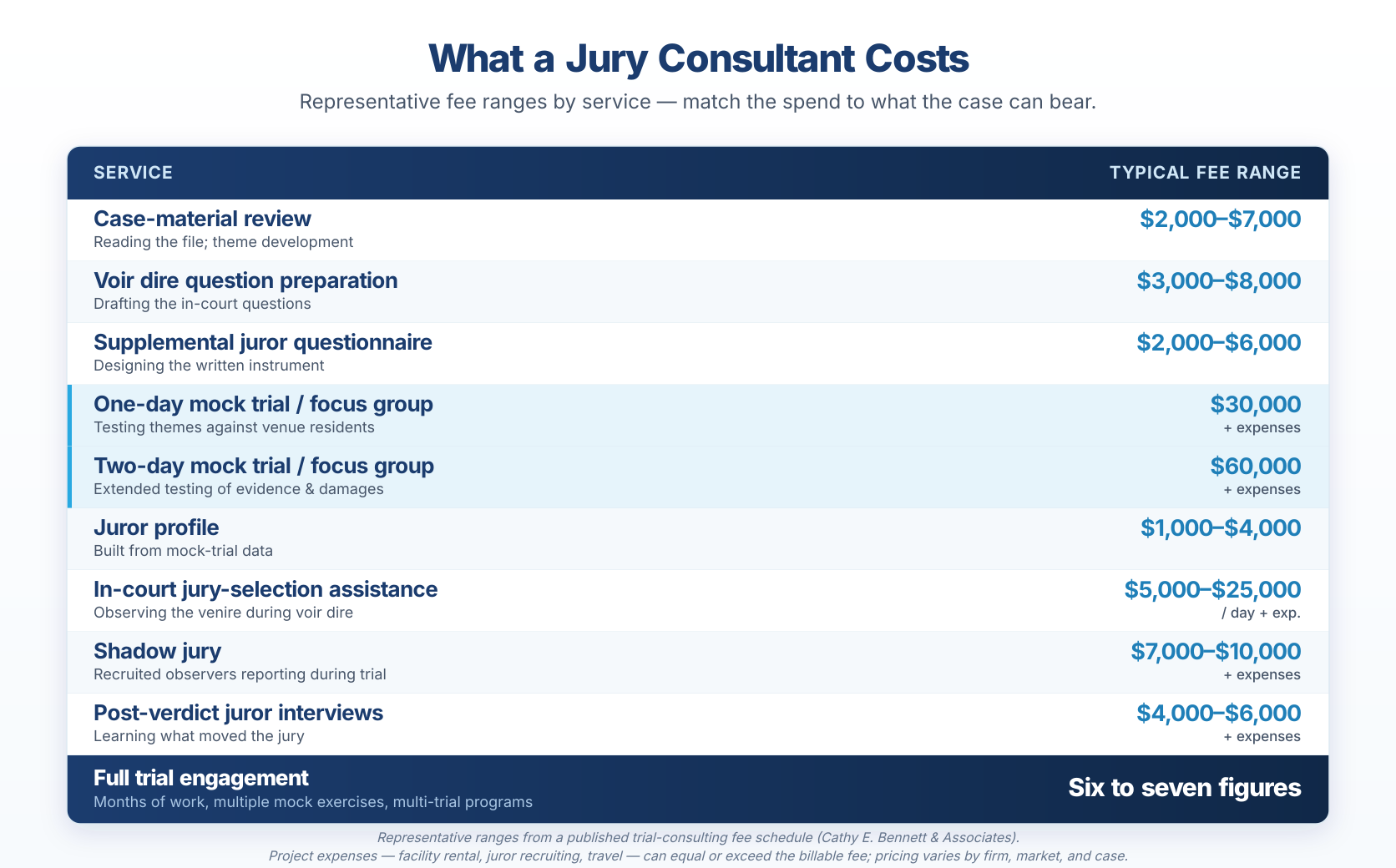
At the top of the market, a full engagement runs well into six and even seven figures. One consulting firm describes budgeting around $500,000 for an in-venue mock trial with deliberations and full trial-team support — and that is one component of a large-case program, not the whole bill. Seven-figure totals are rarely a single exercise; they are an accumulation — multidistrict or mass-tort litigation, a team retained for months, several rounds of mock exercises, and shadow juries running across more than one trial. The point is not that consultants are overpriced; it is that the cost is large enough that you should match it deliberately to what the case can bear.
What attorneys can do on their own
A great deal of what makes jury selection effective is method, not money — and the method is available to any trial team willing to prepare:
Draft a solid baseline questionnaire. A well-built supplemental juror questionnaire surfaces attitudes and experiences on paper, where jurors tend to answer more candidly than they do aloud. Designing one that survives judicial scrutiny — and that does not tip your strategy to opposing counsel — is genuinely hard, and it is one place a consultant's drafting experience earns its fee. But you can get most of the way there on your own by building from open-ended attitude questions tied to your case rather than rigid demographic check-boxes.
Run structured, open-ended voir dire. As covered in our guide to voir dire questions, open-ended questions that invite jurors to talk about past experience reveal far more than "Can you be fair?" ever will.
Rank on attitudes, not demographics. Build a strike priority list driven by what jurors actually say and have done, not by profession, age, or zip code — the predictors the research says are weak.
Take collaborative notes and track challenges in real time. Much of what a consultant's second set of eyes provides is captured observations and accurate challenge counts. A trial team that divides the work — one attorney questioning, another recording attitudinal notes — and tracks strikes carefully recovers a large part of that value on its own. Solo practitioners feel this most acutely: with no second chair, you are questioning the panel and trying to record what each juror says at the same time, which is exactly where the execution gap is widest — and where the right tooling does the most to close it.
The middle ground: software closes part of the gap
Between "hire a six-figure consultant" and "manage it on legal pads" sits a practical middle ground. It helps to separate the two distinct gaps a consultant fills. The first is a research gap — empirical data about how real people in your venue react to your case, produced through mock trials and focus groups. Software cannot close that gap, and you should not pretend it does; the research is what you are genuinely paying a consultant for. The second is an execution gap — keeping every juror's questionnaire data, attitudinal notes, ratings, and flags organized and visible, letting the whole team contribute in real time, and tracking for-cause and peremptory challenges without losing count. That gap is operational, not empirical, and it is exactly where software earns its keep, for a fraction of consultant cost.
For solo attorneys and small firms in particular, this is the part of the consultant's value that was previously out of reach — not because the method was secret, but because the coordination was hard to pull off on paper.
Closing the gap with Jurybox
Jurybox is built to close that execution gap. You can pre-load questionnaire data onto each juror's card before trial, take collaborative notes that your whole team shares in real time, rate and flag jurors as voir dire unfolds, and track for-cause and peremptory challenges automatically by side — so your strike priority list and your challenge count live in the same place you are already working. The preparation you put in does not get stranded on a stack of legal pads the moment the panel starts moving quickly; it stays organized, visible to the whole team, and usable at the speed voir dire actually runs. That is the kind of tooling that used to require a large trial team or an outside consultant, now available to a solo practitioner or a small firm. See how it works in the Jurybox how-to guide.
If your case genuinely needs mock-trial research and venue surveys, hire a consultant — that information is worth paying for. For the much larger set of cases that mostly need disciplined preparation and clean execution in the courtroom, the gap you have to close is operational, and you can close most of it yourself. Try Jurybox free for 3 days — no credit card required.
Sources
Lieberman, J.D. (2011). The Utility of Scientific Jury Selection: Still Murky After 30 Years. Current Directions in Psychological Science, 20(1), 48–52.
Sommers, S.R. & Norton, M.I. (2007). Race-Based Judgments, Race-Neutral Justifications: Experimental Examination of Peremptory Use and the Batson Challenge Procedure. Law and Human Behavior, 31(3), 261–273.
Cathy E. Bennett & Associates. Consulting Services (fee schedule).
Lopez, K.J. (2018). How Much Do Jury Consultants, Litigation Graphics, and Hot-Seaters Cost — Honestly? Persuadius (formerly A2L Consulting).
IMS Legal Strategies. What Does a Mock Trial Cost?
Lat, D. Why Jury Trial Consultants Are Now Essential In High-Stakes Trials. Original Jurisdiction.